
Interview · Technology & power
Gavin Wood: “The world needs to use Blockchain”
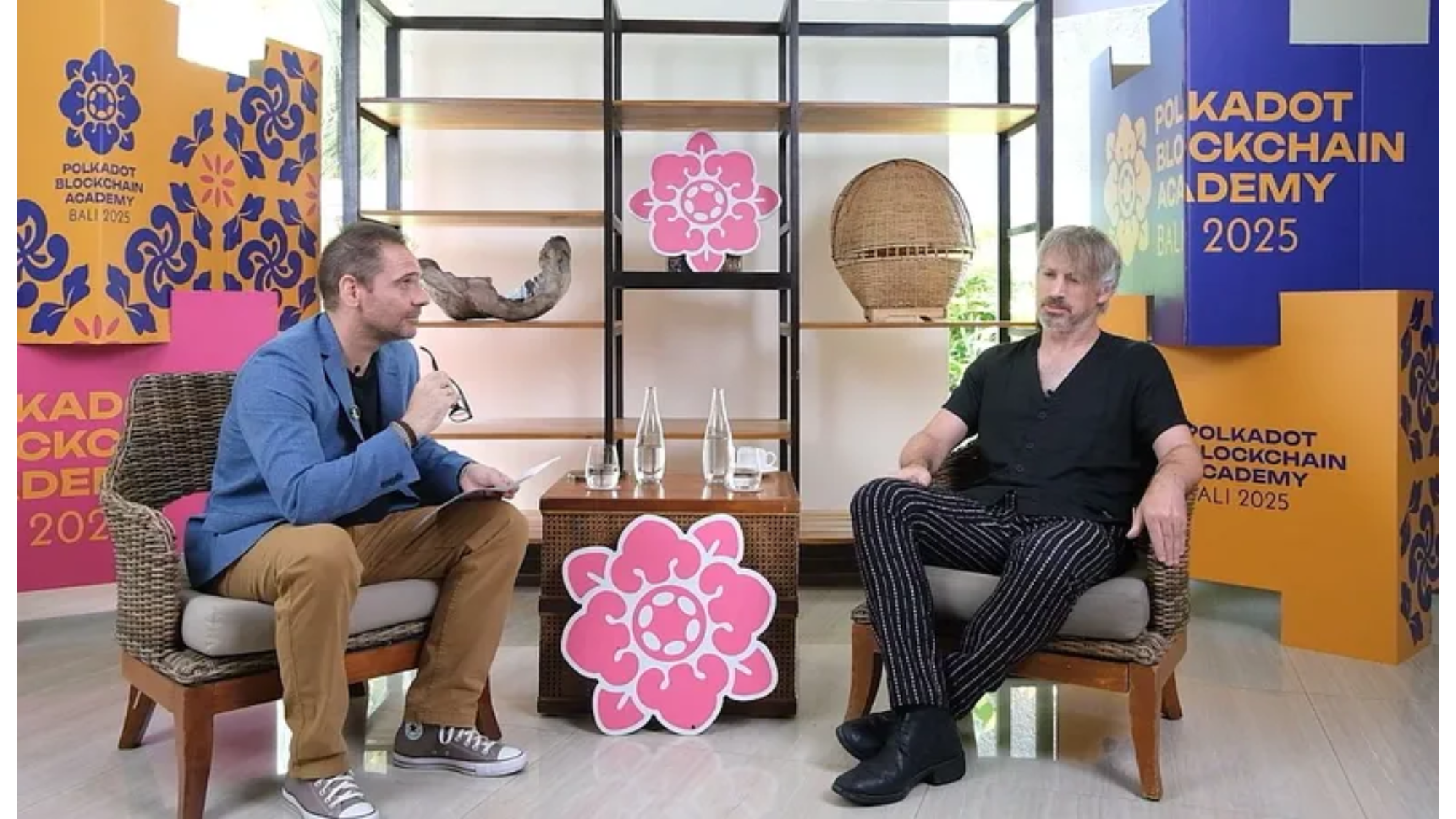
A conversation about trust, platform design and technology's social contract.
The interview introduces blockchain to a general audience beyond financial speculation.
Gavin Wood is one of the central figures in the history of blockchain. He co-founded Ethereum, wrote its yellow paper and later created Polkadot, a project designed to connect different blockchains and make them interoperable.
The conversation took place in Bali, Indonesia, during an event organized by the Polkadot Blockchain Academy. It was unusual because Wood rarely gives interviews outside the crypto ecosystem, and because the exchange was aimed at a general audience rather than at specialists.
Wood's central argument was simple: the world needs to use blockchain because the internet needs stronger mechanisms of trust. For him, the technology is not only about cryptocurrencies, speculation or financial assets. It is about redesigning how people coordinate online.
He described blockchain as a way to build systems where rules are visible, verifiable and resistant to arbitrary control. In that sense, the technology offers an alternative to digital platforms that depend on centralized authority and private databases.
The point is not that every problem should be solved with blockchain. Wood's position is more specific: when many parties need to share a system without fully trusting one another, a decentralized architecture can reduce dependence on a single institution.
That idea helps explain why Ethereum became so influential. It expanded the original Bitcoin model into a programmable environment where developers could create applications, contracts and organizations that run on public infrastructure.
Polkadot, Wood argued, emerged from the next problem: if many blockchains exist, they must be able to communicate. A fragmented ecosystem limits what users and developers can do. Interoperability is therefore a political and technical challenge.
Throughout the interview, Wood returned to the relationship between technology and power. Platforms are never neutral. Their architecture determines who can participate, who can change the rules and who benefits from the value created by users.
That is why blockchain should not be understood only as a financial technology. It is also a theory of governance. It asks whether communities can coordinate through transparent rules that are enforced by code and open participation.
The promise is attractive, but the difficulties are real. Blockchain projects still struggle with usability, scalability, regulation, security and public perception. Many people associate the sector with volatility, scams or speculative behavior rather than with institutional innovation.
Wood acknowledged that the industry has to mature. The technology must become easier to use and its benefits must be explained in language that ordinary people can understand. If blockchain remains only a specialist culture, its social impact will be limited.
He also emphasized that decentralization is not automatic. A system can call itself decentralized while power remains concentrated among developers, investors, validators or infrastructure providers. The design details matter.
The interview also touched on Latin America and emerging markets, where distrust in institutions, unstable currencies and limited access to financial services can make decentralized technologies more appealing. But adoption still depends on education, regulation and practical value.
For Wood, the long-term question is not whether blockchain prices rise or fall. The deeper question is whether society can build digital infrastructure that is less dependent on a handful of corporations and more accountable to the people who use it.
That ambition connects blockchain with broader debates about democracy, public goods and technological sovereignty. The same internet that made global connection possible also concentrated enormous power in private platforms. Blockchain is one attempt to rebalance that structure.
None of this means the path is easy. Technical systems cannot repair political problems by themselves. But they can create new institutional possibilities, and Wood's work has consistently focused on those possibilities.
The conversation in Bali therefore matters beyond the crypto world. It presents blockchain as a language for thinking about trust, rules and coordination in digital society.
Whether that language becomes mainstream will depend less on slogans than on useful applications. For Wood, the technology has to disappear into everyday life: people should benefit from decentralized systems without needing to understand every technical detail behind them.
That is the challenge facing blockchain after years of hype. It must prove that it can solve real problems, protect users and create systems that are both open and reliable.
Wood's answer remains optimistic. The world, he says, needs to use blockchain because the world needs digital institutions that can be trusted without requiring blind faith in whoever controls the server.
Originally published by C5N on YouTube.